
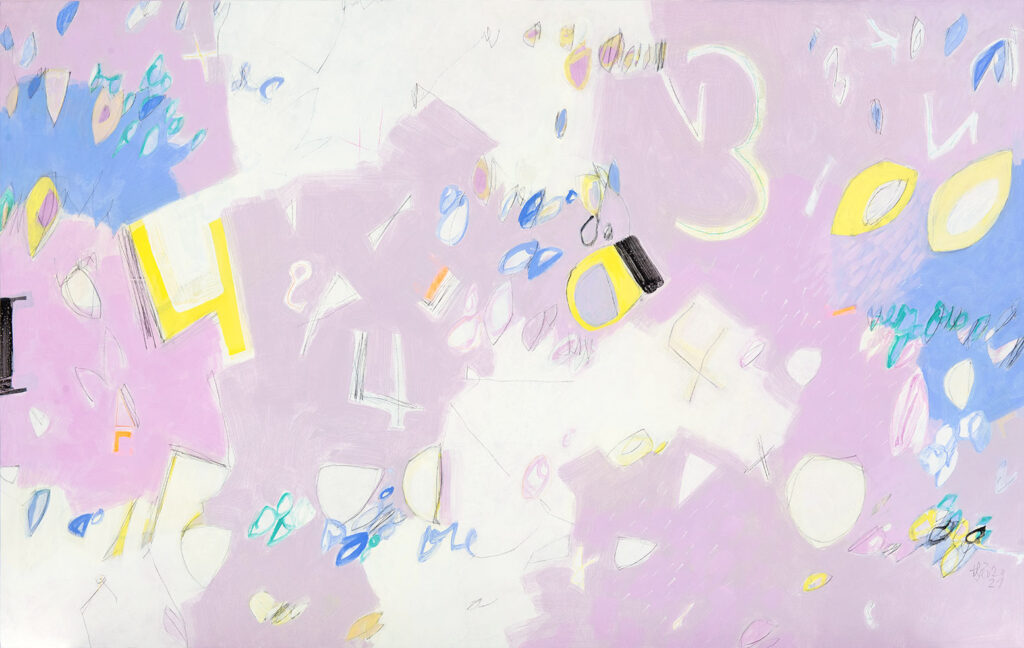
Thảo’s most recent series of paintings Breeze on the River, achieving new ambitions in scale and a continued engagement with palimpsestic method, reflect even stronger intentionality and systematic process. Inspired by our psychological interactions with nature, and the calming effects of riverine currents of air and water, the paintings allude to the flitting images, memories, and seasations that become more lucid and find order when the mind is stilled. The paintings seem to register this state of transition, of agitation finding resolution, auguring tranquility. His recurring fields of white and blue tints become pure expanses of space and sensation – color fields, yes – but they refuse total absorption.
This is by virtue of Thảo’s choosing to evacuate small, singular areas of the top layers of paint to expose and frame unexpected forms that emerge from the underpainting,
which in some instances are further accentuated with scrawls and symbols.
These figures and frames interrupt immersion and a fixed distance between viewer and surface, necessitating an investigative, mobile, sometimes forensic perusal. The paintings thus provide numerous sites and scales of interaction: from the layering of colors and forms through the canvas’s geological space; to the search beyond the frame for the worldly references that have inspired the motifs and expanses of hues within; to the sharing of ambience and radiance between viewers and the large-scale canvases that produces immersive relations.
In his distinctive engagement with abstraction over the last thirty years, Trần Văn Thảo thus continues to mine abstract painting for its accommodation of paradox and possibility, as described in the passage from Tạ Tỵ that opened this essay: “The magnitude of abstract painting no longer resigns us to limited shapes and sizes … but it extends into infinity. Standing before an abstract painting, viewers find themselves in self-reflection, as though they confront eternity, there, a complexity no longer restricted to the canvas.”
– Tạ Tỵ, “Nỗi xao xuyến của hội họa trừu tượng,” (“The Upheaval of Abstract Painting”) Nghệ Thuật 65, October 16-23, 1965, p. 10. 1
Pamela N. Corey
Fulbright University Vietnam